 Skip to the content


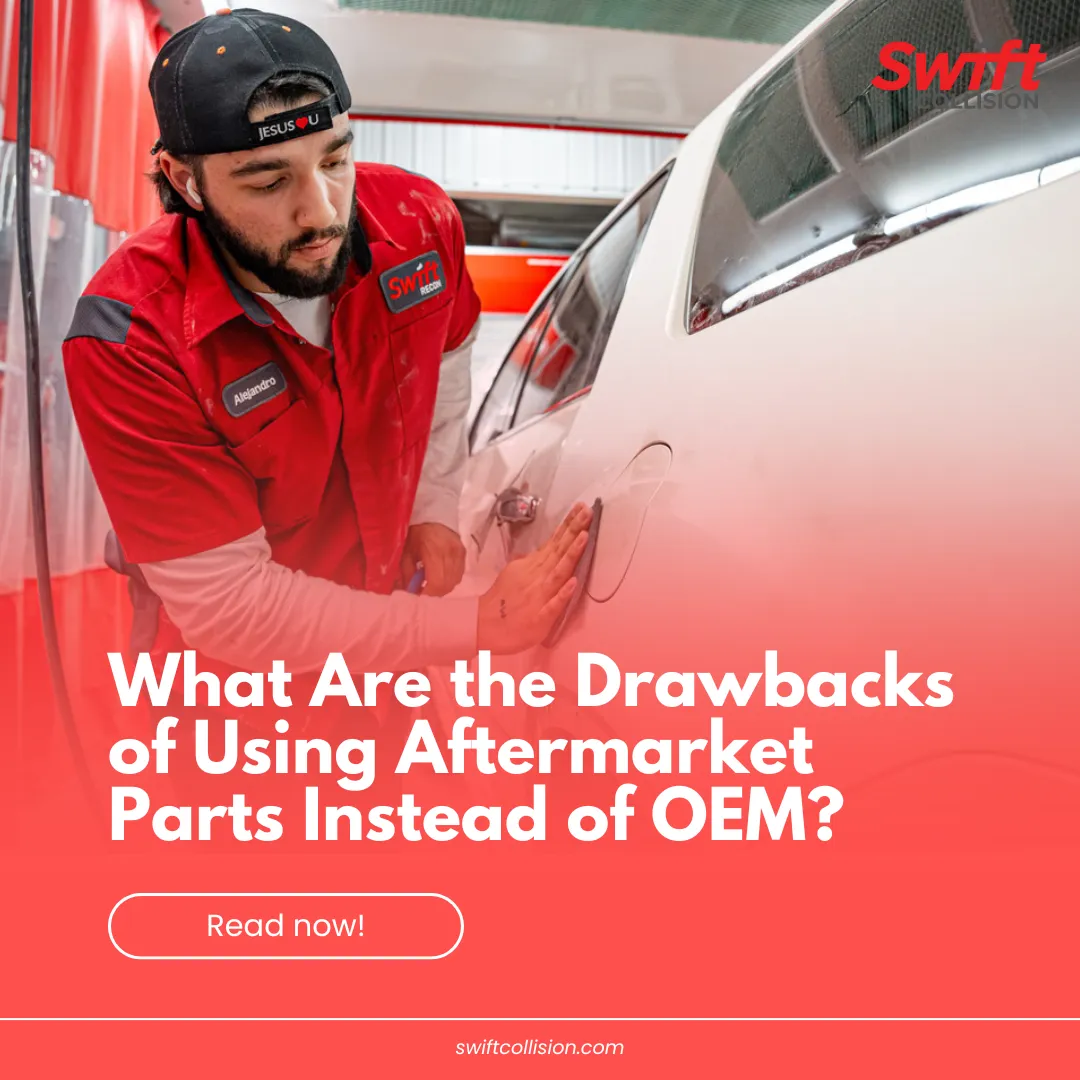
What Are the Drawbacks of Using Aftermarket Parts Instead of OEM?
The Short Answer
Aftermarket parts may save money upfront, but they rarely match the precision, safety, and performance of OEM (Original Equipment Manufacturer) parts. When it comes to auto body repair, using non-OEM components can lead to poor fit, lost resale value, safety risks, and even denied insurance claims. That’s why at Swift Collision in Broken Arrow and Tulsa, we always fight to use OEM parts whenever possible — ensuring your vehicle is restored to factory standards and backed by our Forever On Track™ Lifetime Warranty.
The Real Difference Between OEM and Aftermarket Parts
After a collision, you’ll often hear two terms: OEM and aftermarket. They may sound similar, but they’re worlds apart in quality and reliability.
- OEM Parts: Made by your vehicle’s manufacturer, these parts are identical to the ones your car was built with. They fit perfectly, meet all safety standards, and maintain your warranty and resale value.
- Aftermarket Parts: Produced by third-party companies, these are often designed to fit multiple makes and models. While cheaper, they typically lack the precision engineering and material quality of OEM parts.
In the auto body repair industry, that difference can mean the gap between a seamless, safe repair — and a repair that causes ongoing problems for years. At Swift Collision, our technicians are trained to follow OEM repair procedures for every make and model we service — including brands like Ford, Tesla, Rivian, Nissan, Subaru, GM, Hyundai, and Kia.
Why Aftermarket Parts Can Be a Risk
When you choose aftermarket parts instead of OEM, you introduce several potential problems that affect your safety, your vehicle’s value, and even your insurance coverage.
1. Poor Fit and Finish
Aftermarket parts are mass-produced to fit a wide range of vehicles. That means they often require adjustments to install — and even then, they rarely match the precision of OEM. Panels might not align correctly, paint may not blend perfectly, and gaps can form between body lines. Over time, those misalignments can cause vibration, wind noise, or water leaks. At Swift Collision, we see this often when customers bring in vehicles previously repaired elsewhere. Even slight misfits can compromise aerodynamics, ADAS sensors, and structural integrity — all of which depend on perfect OEM alignment.
2. Weakened Safety Systems
Modern vehicles rely on advanced materials and integrated safety systems — especially ADAS (Advanced Driver Assistance Systems) like lane departure warnings, blind spot detection, and collision avoidance. OEM parts are built to exact factory tolerances so these systems work properly. Aftermarket panels, bumpers, and brackets can throw off sensor alignment and calibration. That’s why every Swift Collision location performs pre- and post-repair electronic scans and ADAS recalibration using Hunter and VSTA equipment. When safety is on the line, guessing isn’t an option.
3. Questionable Material Quality
Many aftermarket manufacturers cut costs by using lower-grade metals or plastics. These materials might look fine initially but tend to:
- Rust faster
- Bend or warp under heat
- Fail sooner in future collisions
In contrast, OEM parts are designed to meet federal safety standards and vehicle crash ratings. Using weaker substitutes can alter how your vehicle performs in an accident — and void portions of your factory warranty.
4. Lower Resale and Trade-In Value
Dealers and appraisers know the difference between OEM and aftermarket parts. A vehicle repaired with OEM components typically maintains higher resale value, while one fixed with aftermarket parts may appraise for less. That’s because OEM repairs are viewed as “factory-equivalent,” while aftermarket parts are often seen as “replacement-grade.” For many Tulsa and Broken Arrow drivers, the small savings up front are far outweighed by long-term depreciation.
5. Possible Insurance or Warranty Conflicts
Insurance companies sometimes suggest aftermarket parts to reduce claim costs. However, in Oklahoma, you have the legal right to request OEM parts for your vehicle. At Swift Collision, our team helps customers exercise that right. We communicate directly with your insurance company to ensure your policy covers genuine OEM replacements whenever possible — protecting both your warranty and your peace of mind.
OEM Parts Protect Safety and Performance
The most important reason to use OEM parts isn’t about looks or resale value — it’s about safety. After a collision, your vehicle’s structure must absorb and redirect impact energy exactly as designed. OEM parts are engineered for that specific purpose. Aftermarket alternatives might not perform the same way in another impact, putting occupants at risk. At Swift Collision, our I-CAR Gold Class and OEM-certified technicians follow every manufacturer’s repair procedures, from Ford F-Series trucks to Tesla EVs and Rivian R1T models. We use factory-approved tools like Car-O-Liner frame systems, PPG Enviro-based paint technology, and precision spectrometer color matching to ensure every vehicle leaves our shop exactly as it rolled off the assembly line.
The Swift Collision Standard: OEM Precision, Every Time
Our philosophy is simple: if it’s not factory-correct, it’s not finished. Every Swift Collision repair includes:
- Genuine OEM parts whenever possible
- Factory repair procedures from each automaker
- Computerized measuring and frame alignment
- Pre- and post-repair diagnostics and ADAS recalibration
- Digital color-matched refinish using PPG Envirobase coatings
- Quality assurance inspections at every stage
It’s not just about making the car look good — it’s about making it safe, reliable, and warrantied for life. That’s the promise behind our Forever On Track™ Lifetime Warranty — covering every repair for as long as you own your vehicle.
How Swift Collision Helps You Get OEM Parts
Navigating insurance claims can be confusing. Some insurers automatically authorize aftermarket parts unless you specifically request OEM. That’s where our team steps in. We:
- Review your policy and state laws (Oklahoma allows OEM requests).
- Communicate directly with your adjuster to advocate for OEM replacements.
- Document all parts used in your repair for transparency and warranty protection.
This advocacy is part of our Swift Care+ program — which also includes:
- Free pickup and delivery anywhere in Tulsa or Broken Arrow
- On-site rental vehicles or rental delivery to your home or work
- Real-time repair updates via the Swift Care app
- Direct insurance coordination to save you time and stress
You shouldn’t have to choose between safety and convenience. At Swift, you get both.
The Cost Comparison: Aftermarket vs OEM
Many drivers assume OEM parts cost significantly more. The truth? The price difference is often minimal — and sometimes insurance will match the cost if you request OEM for safety reasons. Here’s a realistic breakdown:
- Aftermarket bumper cover: $400–$600
- OEM bumper cover: $500–$700
- Paint and labor: Identical for both
That small difference (often less than $100) can determine whether your ADAS sensors recalibrate correctly and your vehicle passes inspection the first time. In the long run, OEM parts save money by reducing return visits, warranty claims, and diminished value.
Swift Collision’s OEM Certifications
Swift Collision is certified by more than 20 major vehicle manufacturers, including:
Tesla, Rivian, Ford, Lincoln, GM (Chevrolet, GMC, Buick, Cadillac, Corvette), Nissan, INFINITI, Subaru, Hyundai, Genesis, Kia, RAM, Dodge, Chrysler, Jeep, and Fiat. Each certification means our technicians have completed factory training and use approved tools, materials, and repair methods. These certifications aren’t purchased — they’re earned through rigorous audits and performance standards.
When your repair is OEM-certified, you’re getting a factory-level restoration, not just a patch-up.
Why OEM Matters More Than Ever (Especially for EVs)
Electric vehicles (EVs) like Tesla and Rivian require precise, high-voltage structural work that only OEM-certified facilities can perform safely. Aftermarket or “unverified” parts can compromise the vehicle’s cooling systems, battery enclosures, and crash structures — all critical to passenger protection. Swift Collision’s EV certifications ensure:
- Proper isolation and battery handling
- High-voltage safety compliance
- OEM-verified aluminum and composite repair methods
If you own an EV in Tulsa or Broken Arrow, trust only an OEM-certified collision center to repair it.
Protecting Your Family and Investment
Your vehicle is more than metal and paint — it’s your family’s safety system. Every weld, panel, and sensor plays a role in how that system performs. At Swift Collision, we don’t take shortcuts. We rebuild every vehicle to factory specifications, not insurance minimums. That’s why we’re trusted by drivers across Broken Arrow, Tulsa, and beyond who refuse to compromise on safety or quality.
Our Promise: Forever On Track™
Every repair we complete is backed by the Forever On Track™ Lifetime Warranty — our written guarantee that the workmanship and materials will stand the test of time. If any issue arises related to the repair, we’ll fix it at no cost for as long as you own your vehicle. That’s how we define excellence: not just restoring your car, but restoring your confidence every time you drive it.
Get a Free Estimate Today
Whether you’re dealing with a minor fender bender or major collision damage, Swift Collision makes the process simple. Visit us in Broken Arrow, OK, or schedule your free online estimate through our AI-powered photo tool — available 24/7. We’ll assess your damage, coordinate your claim, and fight to use OEM parts wherever possible. Your car deserves to be repaired the right way — the Swift way.
Frequently Asked Questions
Q: Are aftermarket parts legal to use in Oklahoma?
Yes. However, you also have the legal right to request OEM parts for your repair. Swift Collision helps you exercise that right by coordinating directly with your insurer.
Q: Will using aftermarket parts void my warranty?
Potentially. Some manufacturers may limit warranty coverage if non-OEM parts affect the vehicle’s performance or safety systems. Swift Collision uses OEM parts to protect your factory warranty.
Q: How can I be sure my repair includes OEM parts?
Ask your repair shop for a written estimate listing part types. At Swift Collision, we document every component and guarantee OEM parts whenever possible — covered by our Forever On Track™ Lifetime Warranty.


